A Winter Garden Walk for Silhouette and Space
A winter garden walk reveals the structure hidden by summer growth, helping you notice branch lines, evergreen mass, open views, and useful places to pause.
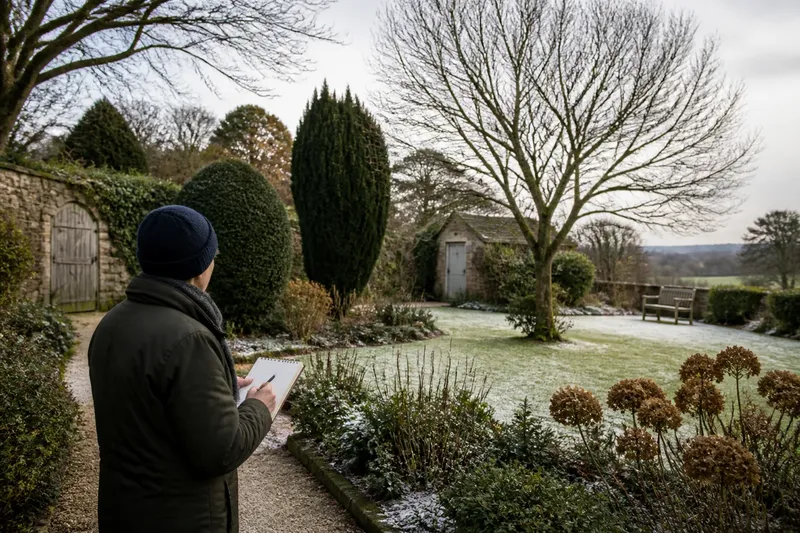
A winter garden walk makes the garden’s structure easier to read: bare branches draw crisp lines, evergreens hold their shape, and open ground shows where the eye can travel. Choose a quiet day when paths are visible, then move slowly enough to notice how these forms relate from one spot to the next.
Choose a route that reveals different views
Start at an entrance or familiar threshold and pick a loop that passes a tree, a shrub border, an evergreen planting, and at least one open area. The route need not cover the whole garden. A short circuit with contrasting views gives you more to observe than a hurried tour of every bed.
Walk the route once at an ordinary pace before stopping to study details. Notice where a view opens, narrows, or turns. A seat, gate, or bend can make a natural pause; these points help you compare what is visible from one position with what disappears from another.
Bring a small notebook and a pencil, or use a phone to photograph the same views from eye level. If you take pictures, include a fixed feature such as a gatepost or wall corner so you can recognize the viewpoint later.
Read bare branches as lines in the air
Choose one deciduous tree or large shrub and look first at its outer outline, not at individual twigs. Does the crown rise like a vase, spread sideways, or form a loose dome? Then trace a few main limbs with your eyes from trunk to tip. Their direction can make the plant seem upright, broad, airy, or compact.
Notice where branches overlap. A dense tangle may create a dark patch against a pale wall, while a more open crown lets the background show through in fragments. Look from a second position, too: a branch that seems to cross the center of the view from the path may frame it neatly from beside a fence.
Imagine a small courtyard where a bare apple tree partly hides a shed door. From the path, you might see that several low branches gather across the doorway; from a nearby bench, the trunk shifts aside and the door becomes visible. Mark both viewpoints in your notebook before deciding whether the tree needs any attention.
Compare evergreen shapes and their weight
Next, look at evergreens as masses rather than as a list of species. A columnar yew, a rounded boxwood, and a spreading juniper occupy space differently, even when their foliage is a similar deep green. Ask which shape holds the eye, which recedes, and whether neighboring forms make a deliberate rhythm or a crowded cluster.
Check the edges of each evergreen against its background. Dark foliage can stand out against snow or a light wall, but merge into a shaded hedge. A pale sky may reveal the outline of a conifer while making its internal branches harder to distinguish. If the shape reads clearly only from one angle, note where that view occurs.
Also observe the ground around each plant. A low evergreen may look anchored by a broad bed, while a narrow upright form can appear to rise straight from a path edge. This is not a verdict on the planting; it is a record of how its outline meets the surrounding space.
Notice what open space contributes
Open ground is not merely a gap between plants. A lawn, dormant perennial bed, gravel patch, or clear strip beside a wall can give the eye room to rest and make nearby forms easier to read. Stand where the open area is broadest, then turn slowly toward its edges. Note which branches or evergreen shapes define the space without closing it in.
Look for the shape of the opening. It may be a clear oval, a narrow passage between beds, or an irregular pocket that widens toward a view. Observe whether the opening directs attention to a useful feature such as a bench, a small tree, or the far boundary, or whether its edges feel visually scattered.
Keep the seasonal condition in mind. A bed that looks empty in winter may be occupied by summer foliage, so record what is visible now rather than treating the bare ground as a permanent design flaw. A quick note such as “open view beside the birch” can help you compare the same place when growth returns.
What should you record on the walk?
Where does a strong silhouette appear?
Write down the viewpoint and the plant that creates it, such as “from the kitchen door, the birch crown against the fence.” This ties the outline to a place you can revisit instead of leaving you with a vague impression.
Which shapes overlap or compete?
Note the forms that merge, cross, or seem crowded from your usual path. Then look from one nearby position to see whether the overlap changes before deciding that the planting itself is the problem.
Where does open space make a view clearer?
Record the patch of lawn, bed, or paving that gives a nearby feature room to stand out. Also note whether that openness depends on seasonal dieback or remains clear through the year.
What should wait until another season?
Mark observations that winter alone cannot settle, such as whether a dormant bed feels too bare or whether a flowering shrub blocks a view in leaf. A note to revisit the spot later keeps a single seasonal impression from turning into a premature change.
Turn observations into a useful next visit
Before leaving, choose one or two viewpoints to revisit when the garden changes. Keep your notes concrete: name the location, describe the outline or opening, and record what lies behind it. A simple sketch can show a tree crown, a dark evergreen mass, and the clear space between them without trying to make an attractive drawing.
Use the winter garden walk to identify relationships, not to rush into pruning or moving plants. A silhouette can look awkward from one angle and balanced from another; open ground can seem vacant now and purposeful once perennials rise. If a change still seems worthwhile later, check the plant’s care guidance and consider asking a qualified arborist about significant tree work.
For a more revealing winter garden walk, revisit the same route after a change in weather or light. Low sun, cloud, and fresh snow can alter the contrast between branches, foliage, and open ground, giving you a clearer sense of which forms hold the garden together.