Bulbs or Tubers? Two Different Ways Plants Store Their Start
Bulbs or tubers? Learn to recognize each plant’s storage organ by its structure, buds, roots, and growth pattern, then handle it with greater confidence.
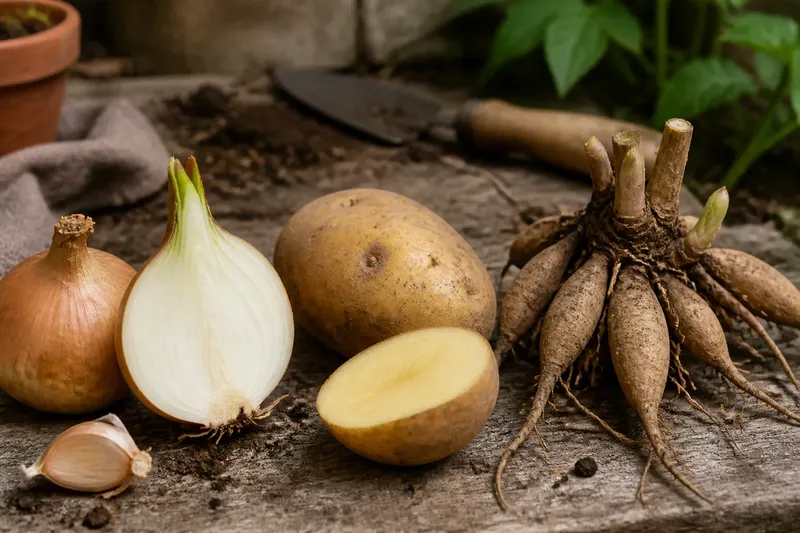
Bulbs or tubers? A cut onion and a potato show the difference at a glance: an onion is built from layered, fleshy leaves wrapped around a short stem, while a potato is a swollen stem with buds scattered across its surface. That structural distinction helps you recognize what you are holding, understand where growth begins, and avoid treating every underground plant part alike.
Bulbs hold leaves around a compact center
Slice a typical bulb lengthwise and you will see concentric layers, much like rings inside an onion. Those layers are modified leaves, thickened to store food. At the base sits a small, flattened stem plate, the bulb’s central anchor. Roots emerge from its underside, and a shoot grows upward from the center.
The arrangement is compact and ordered: leaf scales enclose a growing point, then the whole organ rests on a basal plate. A tulip bulb, for instance, has a papery outer covering and pale, fleshy scales inside. A lily bulb lacks that tidy papery coat and instead shows visible, overlapping scales. Both are bulbs, despite their different outer appearances.
Not every bulb has the same shape or covering, so an intact specimen can be harder to identify than a cross-section. Look for the basal plate and the layered construction, not merely a rounded outline. A swollen, round object is not automatically a bulb.
Tubers store growth in a swollen stem
A stem tuber, such as a potato, is a thickened underground stem. Its buds appear as small dimples or “eyes” across the surface. Each eye can produce a shoot; roots generally arise after those shoots begin to grow. Unlike a bulb, a tuber does not contain a stack of fleshy leaf scales wrapped around a central plate.
That difference is visible in the way a tuber is organized. A potato has a skin, solid flesh, and several bud points distributed over its surface. A bulb has layers arranged around a central axis. A potato’s eyes are not random blemishes: they mark nodes on the stem from which new growth can emerge.
“Tuber” can also refer to a swollen root, as in a dahlia’s storage structures. Those are not the same thing as a potato’s stem tuber. Dahlia tuberous roots store food, but the new shoots arise from the crown, where the roots join the stem, rather than from eyes scattered over each root. The word alone does not tell you exactly where the growing points are.
Follow the buds to find the plant’s starting point
When a plant part is unfamiliar, locate its buds before deciding how it is built. A bulb’s shoot point is usually at the top, opposite the root-bearing basal plate. A potato’s eyes are distributed across its surface. A dahlia’s crown carries the buds, so a detached, swollen root without a piece of crown may have no visible starting point for a new shoot.
That makes orientation easier to judge for some organs than others. With a bulb, the flat basal plate generally points down and the growing tip points up. With a potato, the eyes can sprout in several directions, so the piece is less dependent on one obvious top and bottom. With dahlia material, the crown and attached roots matter more than simply placing the fattest section downward.
Imagine you have a loose potato and a small, unfamiliar bulb beside a planting bed. You spot several dimples on the potato but one flat plate and a pointed top on the bulb. Those clues suggest that the potato carries multiple stem buds, while the bulb’s growth is organized around one central shoot; you can set each aside with its structure in mind rather than guessing from shape alone.
What should you inspect on an unfamiliar storage organ?
How can I tell a bulb from a tuber without cutting it?
Look for papery or fleshy scales and a basal plate, which point toward a bulb. A solid body with distinct eyes across its surface is more consistent with a stem tuber, while a swollen root attached to a crown may be a tuberous root.
Are all tubers potatoes?
No. Potato is a familiar stem tuber, but gardeners also use “tuber” for other swollen storage organs, including root tubers. Check where buds form: potato eyes sit across the stem tuber, while dahlia shoots emerge from the crown.
Can one bulb make more than one shoot?
It can. A bulb may contain a main growing point and develop offsets, or smaller daughter bulbs, alongside it. The layers still surround a compact basal plate, even when several shoots or offsets are present.
Why does a dahlia root look different from a potato?
A dahlia’s swollen storage roots are roots, not enlarged stems with potato-like eyes. Their connection to the crown is important because the crown holds the growing points; a plump root by itself does not show the same pattern of buds as a potato.
Growth patterns reflect the shape of the reserve
A bulb’s stored food is held mainly in its fleshy leaf scales. The central shoot uses that reserve to begin growth, and new leaves later help replenish the organ. When a bulb produces offsets, the small new bulbs develop beside the original, linked to its compact base rather than appearing as scattered buds across the scales.
A stem tuber’s buds are nodes on an underground stem. When an eye sprouts, it produces a shoot that grows above ground; the plant can later form new tubers on underground stems. The pattern is branching and distributed, not a single set of layers feeding one central shoot. A root tuber follows another pattern again: its storage root is connected to a crown or stem region that bears the shoots.
These distinctions explain why a bulb and a tuber can look equally substantial while behaving differently. Their size or weight says little about where new growth will emerge. Bud location and internal structure offer better clues.
Handle each organ according to what it reveals
A bulb’s basal plate is its root-bearing base, so avoid scraping or breaking it while inspecting the organ. Its scales can be damaged too, but a loose outer skin may simply be a dry protective layer rather than the living structure that holds the roots. For a cut bulb, the layers and central base are more informative than the surface color alone.
On a potato, eyes are the useful landmarks. If you are examining one for garden propagation, consider whether the piece retains a sound bud and follow the seed supplier’s handling directions. Do not assume that a smooth cut face will sprout just because the piece is thick; the eyes, not the flesh by itself, identify potential shoot points.
For a dahlia, keep the crown in view when dividing or sorting stored material. A cluster of swollen roots may look like a handful of separate planting pieces, but the relevant question is whether each piece remains connected to a viable crown section with a bud. Labels and supplier directions take precedence for handling and planting details, since procedures vary by plant and stock.
Bulbs or tubers become easier to identify with a few clues
Use a short inspection rather than relying on a plant name or a rounded silhouette:
- Check for layers. Overlapping fleshy scales arranged around a center suggest a bulb.
- Find the base. A compact basal plate with roots beneath it is characteristic of many bulbs.
- Look for eyes. Buds distributed over a solid, swollen stem point toward a stem tuber.
- Trace the crown. On a dahlia, identify where swollen roots meet the stem and where shoots can emerge.
- Notice the growth pattern. A bulb’s central shoot and possible offsets differ from a tuber’s spread of buds or a root tuber’s crown-based growth.
Bulbs or tubers are not simply two names for underground reserves. A bulb is a layered shoot with food stored in modified leaves; a stem tuber is a thickened stem whose eyes mark growth points; a root tuber stores food in swollen roots connected to a crown or stem. Once you know where the buds, roots, and central structure sit, the object in your hand becomes easier to read—and easier to handle with care.