From Gravel to Brick: Why Garden Paths Took Different Forms
Garden path history reveals how gravel, brick, stone, and earth shaped movement and garden layouts, with clues to read in an old path today.
Garden path history is written in the routes that link a doorway to a kitchen garden, or a house to a formal walk. Gravel, brick, stone, and earth each leave different clues about how a garden was used and maintained, though no material has one fixed meaning across every place and period.
Garden path history depends on place and purpose
A path’s material makes the most sense alongside its setting. Local geology, nearby building materials, the garden’s purpose, and the work available to maintain a route all shaped what could be used. A path through productive beds might prioritize access; a walk near a house could also be part of a designed view.
Those distinctions are not a simple progression from humble earth to refined paving. Gardens have been made for work, display, recreation, and combinations of all three. A costly or carefully laid surface could appear in one part of a garden while a plain track served another. The route’s relationship to its surroundings is often more revealing than a broad label such as “formal” or “natural.”
Gravel records both design and upkeep
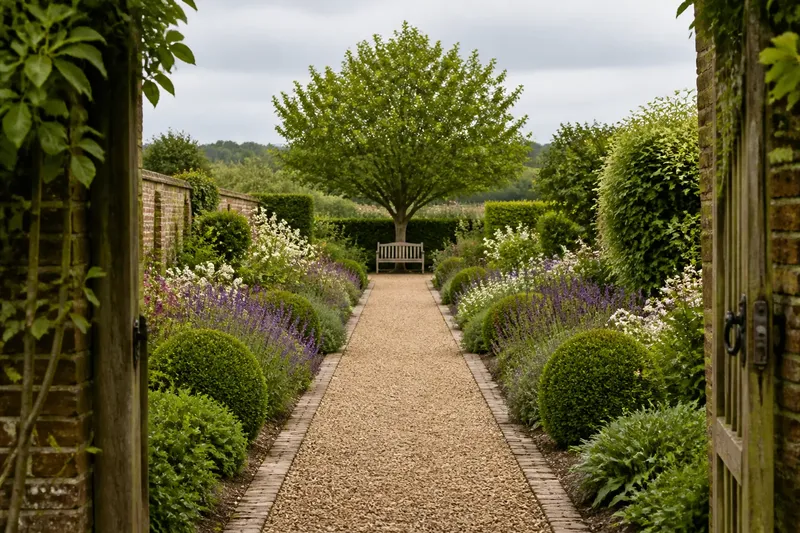
Gravel’s loose texture can merge visually with planting or open ground, but it is not automatically an informal choice. A clearly edged gravel walk can have a deliberate shape, and its crunch gives footsteps a distinct sound. In some gardens, that audible surface also made approaching visitors easier to notice.
Loose aggregate shifts under repeated traffic and can spill into beds or settle unevenly. Those changes leave useful evidence: a worn line may point to a preferred route, while a thicker layer near an edge may reflect later upkeep. Such clues need context; a gardener may have renewed or altered a path long after its original layout.
Look for where the gravel meets borders, steps, and doorways. Those junctions can show how the route was contained and where movement concentrated.
Brick connects a route to built surroundings
Brick paths are made from repeated units, so their joints and laying pattern remain visible. Brick could be used where it was locally available or suited to nearby construction; its presence alone does not establish the garden’s date, cost, or intended status. A path beside a wall may share its material, while a contrasting brick can mark a change in route or space.
Patterns and repairs add further clues. A change in bond, brick size, or color may indicate a later alteration, but weathering and replacement can also create variation. Read the surface with the surrounding walls, steps, and garden plan rather than treating one feature as a precise historical label.
Individual units can be lifted and replaced, although the condition of a path depends on its construction and later care. A settled or patched area may record both the original work and the practical adjustments made over time.
Stone and earth reflect local conditions
Stone paths vary widely. Regularly cut slabs can create a measured route; irregular pieces may follow uneven ground or thread between planting. Where stone came from nearby, its color and texture could connect a garden to its setting, but imported stone and reused masonry complicate that reading.
Earth tracks can be unobtrusive and direct, especially where people regularly crossed a working garden. Their condition changes with weather, drainage, and foot traffic. A bare strip may have been an intended path, or it may simply mark a route that developed through repeated use.
Compare the path with the garden’s slope and drainage. A low, wet section may explain why a surface was later raised or replaced.
Read a path by its route, wear, and repairs
Alignment can suggest what a path connected: a door, a work area, a water source, a seat, or another garden space. Wear may indicate frequent passage, but not necessarily the original design. Later changes to entrances, planting, or buildings can shift a route’s purpose.
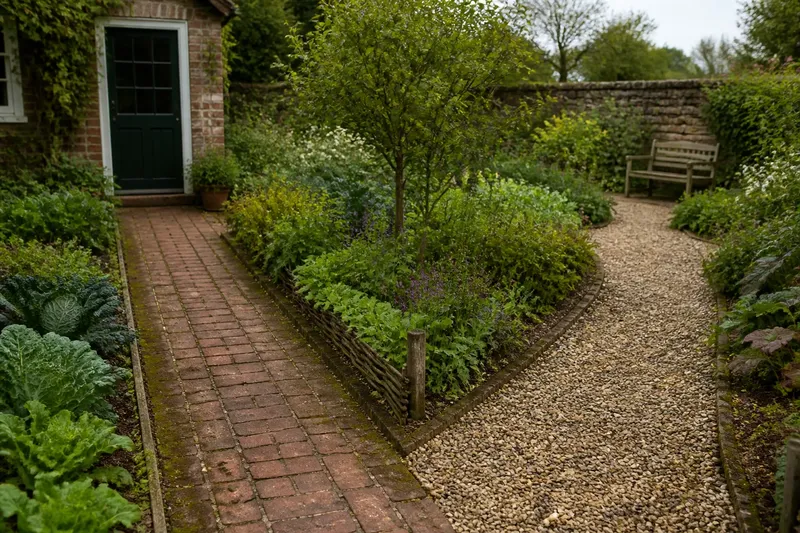
Imagine an invented garden with a brick strip leading from a back door toward a former kitchen bed and a gravel branch continuing to a bench. To interpret it, first note the door, bed, bench, and path junction; then compare wear on both branches and inspect where brick meets gravel. If the brick is worn near the door and the gravel branch shows little disturbance, the evidence suggests more frequent use of the direct route, but it does not prove when or why the paths were laid. A changed bed or moved bench could account for the contrast.
Use a simple set of observations before assigning a story to an old path:
- Check whether the route meets a doorway or gate; if it does, consider regular access as a likely purpose, and if it does not, compare it with nearby entrances before drawing a conclusion.
- Check where wear is concentrated; if one section is more worn, consider heavier passage there, and if wear is even or absent, look for resurfacing or limited use as alternatives.
- Check how the path meets beds and borders; if edges are consistent, consider deliberate containment, and if they wander, investigate later planting or material movement before calling the design informal.
- Check for repairs or changes in material; if joints, units, or aggregate differ, consider a later patch or alteration, and if they match, do not assume that proves the path is original.
- Check the route against the slope and drainage; if it avoids low ground, consider water management, and if it crosses it, look for raised sections or later changes before judging the original choice.
- Check whether nearby walls or steps use related materials; if they do, consider a connection in supply or design, and if they do not, allow for local availability or later replacement rather than treating the contrast as a firm date clue.
How can gravel, brick, and other paths be interpreted?
Why were some paths left unpaved?
Earth could provide a direct route without a constructed surface, especially in working areas. Weather, drainage, and traffic affect how well it serves, so an unpaved track may reflect either an intentional choice or simple repeated use.
Did gravel always mean an informal garden?
No. Gravel can be carefully edged and arranged, while loose texture alone says little about the designer’s intentions. Consider its shape, position, and relationship to planting and buildings.
Why use brick instead of stone?
Brick may have been accessible or suited to nearby construction, while stone offered different local and visual possibilities. The specific reason depends on the place, period, and surviving evidence, not on the material alone.
Can an old path reveal how a garden was used?
Its alignment, wear, and repairs can suggest patterns of movement. Treat those signs as clues to weigh against the wider layout, since later changes can reshape a route or erase earlier evidence.
Preserve the evidence before changing an old path
Before repairing or redesigning a historic route, record its alignment, surface, edges, and points of connection. Photographing the path and noting changes in material can help distinguish what appears continuous from what may be a later repair. If the garden is part of a protected historic property, consult a qualified preservation professional or the relevant local authority before altering it.
Garden path history is most useful when it encourages careful observation rather than a quick verdict. A junction between gravel and brick, a worn threshold, or a repaired edge can help explain how a garden’s routes changed. Read those details alongside the surrounding layout, and leave room for more than one interpretation.